Keep a cat off the kitchen counters (when foil and tape stopped working)

The problem
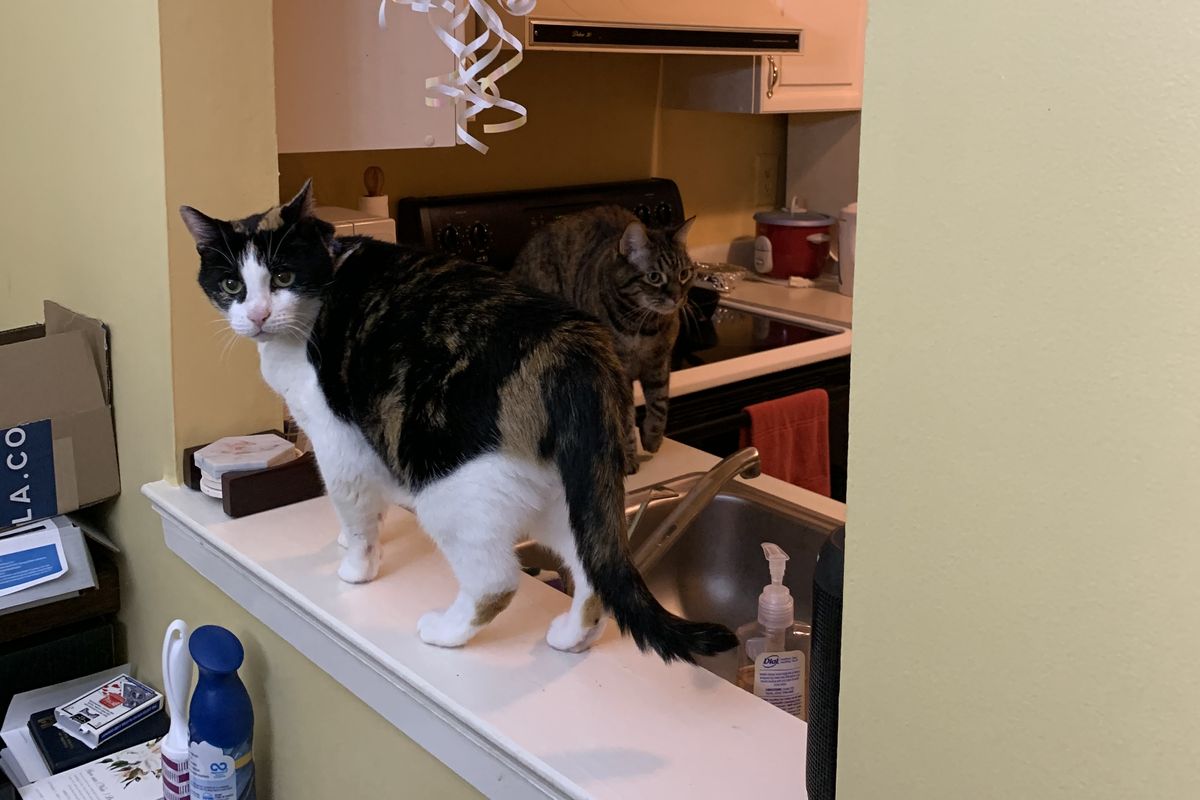
You turn around to grab a pan and the cat is on the counter again, nose in the butter, paws next to the cutting board. You leave the room and come back to a glass on the floor. Foil worked for a week. Double-sided tape worked for two. Now the cat steps right over it.
That’s the usual story, and it has a reason: deterrents only teach a cat that a spot is unpleasant. If the counter still has food, running water, a window, or the best view of you, the cat will keep testing it, and once foil turns out to be harmless, it stops working. What works is doing three things at the same time: take away what the counter gives them, give them a better place nearby, and use deterrents only to cover the gap while the new habit sets in.
Rule of thumb: a clear counter, a cat perch with a view of the kitchen, and treats for using it beat any spray or mat. Expect a few weeks of consistency from everyone in the house, and expect some counter cruising when nobody’s home, so put away anything that can break or hurt them.
Step 1: Figure out why your cat goes up there
| What you notice | Likely reason | First fix |
|---|---|---|
| Jumps up while you cook or when food is out | Food smells and crumbs | Clear and wipe counters, store food in closed containers, keep the cat in another room during prep |
| Heads straight for the sink or faucet | Wants running or fresh water | Offer a cat water fountain or extra water bowls away from the kitchen |
| Sits by the kitchen window | Wants the view | Put a window perch or cat tree at a different window |
| Jumps up when you’re standing there and ignoring them | Attention, or wants to be at your height | A stool or cat tree near (not touching) the counter, plus a short play session before you cook |
| Up there mostly when you’re out or asleep, knocking things off | Boredom and exploring | More play, puzzle feeders, and put breakables away |
| Uses the counter to escape a dog, kids, or another cat | Wants a safe high spot | Give them a tall perch or a gated room the other animal can’t reach |
Step 2: Free fixes to start today
- Make the counter boring. No dishes left out, no crumbs, no cat food prepared there, no open butter or bread. If a cat never finds anything up there, it stops checking.
- Block it before the jump, not after. When you see the cat eyeing the counter, step in front, say a calm “no” or call them, and reward them for staying down or going to their spot. Lifting them off after they land teaches less.
- Close the kitchen during meal prep. If you have a door, keep the cat in another room with water, a bed, and toys while you cook, then let them out.
- Play before you cook. Ten minutes with a wand toy before dinner prep takes the edge off a bored cat.
- Put the sponge and dish soap away. Some cats lick or chew them; it’s also one less thing to knock into the sink.
- Get everyone on the same rules. If one person lets the cat sit up there “just this once,” the cat learns the counter is sometimes allowed and keeps trying.
Step 3: Give them a better place to be
This is the part most people skip, and it’s the part that makes deterrents stick. Cats want height and a view. Give them a legal spot that’s at least as good as the counter.
- Pick a spot where the cat can see you in the kitchen but can’t step onto the counter from it. A cat tree a few feet away, a stool with a cat bed on it, or a window perch all work.
- Make it nicer than the counter: a soft bed, a little catnip or silvervine, and a toy.
- Every time the cat uses it, give a treat or praise. Feed a few meals or treats there so it becomes their spot.
- When the cat lands on the counter, calmly carry or call them to the perch and reward them there.
- Keep rewarding for a few weeks after it seems to work, then taper off slowly.
Step 4: Passive deterrents, used the right way
Deterrents work best on a cat that’s just started, or alongside Step 3 for a cat that already knows the counter is safe. Use them for a few weeks, then remove them one spot at a time.
- Double-sided tape on placemats, not the counter. Stick tape to cheap plastic placemats and lay them across the counter when it’s not in use. Cats dislike the sticky feel, and you can pick the mats up to cook instead of peeling tape off stone or laminate.
- Plastic carpet runner, nub side up. The little grippers on the bottom of a vinyl runner feel odd under paws but don’t hurt. Cut pieces to fit the counter edge.
- Foil or a sheet pan near the edge. Free and fine for a fast start, but most cats figure out that foil is harmless.
- Cover the jump-up spot. Cats often use the same chair, stool, or trash can to get up. Push chairs in, move the stool, or swap in a can with a lid.
Step 5: The products, compared
| Product | What it does | Good for | Watch out for | Shop |
|---|---|---|---|---|
| Double-sided anti-scratch / deterrent tape (e.g. Sticky Paws strips) | Sticky surface cats don’t like to step on | Counter edges, placemats, the top of the jump-up chair | Can leave residue on some counters; test a hidden spot or put it on placemats. Dust and fur make it less sticky, so replace it. | Check on Amazon |
| Clear plastic placemats | A base for tape that you can lift off when you cook | Kitchen counters and dining tables | Buy several so you can cover the whole run of counter the cat uses. | Check on Amazon |
| Vinyl carpet runner (gripper-back) | Nubs up, it gives an uncomfortable but harmless surface | Counter edges, windowsills, tables | Cut to size with scissors. Not pretty, so treat it as temporary. | Check on Amazon |
| Cat window perch | A window seat or hammock that gives the cat a view somewhere other than the kitchen counter | Cats who go up for the kitchen window | Check the weight limit, and follow the maker’s instructions for the window type. Suction cups need clean glass. | Check on Amazon |
| Tall cat tree or wall shelves | Gives height and a lookout the cat is allowed to use | Cats who want to watch you, multi-cat or dog homes | Place it where the cat can see the kitchen but can’t jump from it to the counter. Wall shelves need to be screwed into studs. | Cat trees · Wall shelves |
| Cat water fountain | Running water away from the sink | Faucet lovers | Needs regular cleaning and filter changes. See our water bowl guide for bowl and fountain options. | Check on Amazon |
| Covered butter dish, bread box, and lidded containers | Takes away the food that rewards the jump | Food-motivated cats | Pick heavy or latching lids; light lids get pushed off. | Butter dish · Bread box |
| Stove knob covers | Keeps paws from bumping front-mounted knobs | Homes with front-knob stoves and a cat who walks the stovetop | Check that they fit your stove model. If your range has a control lock, use it. | Check on Amazon |
| Museum putty | Holds small items in place so a paw swipe doesn’t send them to the floor | Decor, canisters, and shelves the cat walks past | Won’t stop a determined cat from tipping something tall. Put true breakables away. | Check on Amazon |
| Treat puzzle feeder | Gives a bored cat a job | Cats who cruise the counters when you’re out | Start with an easy setting so the cat doesn’t give up. | Check on Amazon |
These are examples of each product type, not ranked picks. Inclusion is not a paid placement; check the current listing for size, price, and what’s included before buying.
When you’re not home
- Assume the cat will explore. Put away knives, glasses, and anything that can break.
- Keep onions, garlic, chocolate, grapes, and cleaning products in cabinets, not on the counter.
- Turn front-mounted stove knobs away or cover them, and use the range’s control lock if it has one.
- Leave the window perch, cat tree, and a puzzle feeder set up so there’s something better to do.
- Wipe the counter before you start cooking, every time. It’s the one step that works even if the training doesn’t.
What to skip
- Spray bottles and yelling. Cats tend to learn to wait until you leave, and it can make them wary of you. Humane groups and vets recommend redirecting instead.
- Shock or static mats. Many owners find them unkind, and you don’t need them for a counter habit. We don’t list them.
- Motion-activated air sprayers. They startle rather than teach, and PetMD advises against forced-air devices. We don’t list them either.
- DIY essential-oil or citrus sprays. Concentrated essential oils can be harmful to cats, and scent sprays on a food surface aren’t a good idea anyway.
- Deterrents with no alternative. Tape and foil without a better perch nearby usually stop working within a few weeks.
If an older cat suddenly stops jumping up, or starts jumping up and missing, mention it at the next vet visit.
Quick decision path
- Only up there when food is out? Clear the counter, store food in closed containers, and close the kitchen during prep.
- Goes for the sink? Add a cat water fountain somewhere else.
- Goes for the window or the view of you? Add a perch or cat tree nearby and reward every use.
- Need a fast start? Taped placemats or a nub-side-up runner for a few weeks, alongside the perch.
- Knocks things off when you’re out? Put breakables away, use museum putty, and give them a puzzle feeder.
Related guides
Find more cat fixes on Pinterest!
Follow Cat Solutions That Work