Stop a cat waking you up at 5am for food (timed feeders, done right)

The problem
It starts around 4:30 or 5. A paw on your face, a head-butt, a nibble on your hair, the thing on the nightstand nudged toward the edge. Shut the door and the cat scratches it or yells in the hallway. You get up, fill the bowl, and the cat is happy. You are not. And after the clocks change in the fall, it gets worse: the cat’s stomach didn’t get the memo, so “breakfast at 6” suddenly arrives at 5.
It’s one of the most common complaints in cat forums, and the advice that keeps coming up is the same: the cat has learned that you waking up means food. Every time you get up and feed them, the wake-up routine worked, so it continues. The fix is to take yourself out of the food chain, usually with a timed feeder, and then stop rewarding the wake-up long enough for the habit to fade.
Rule of thumb: a timed feeder fixes the food part; it doesn’t fix a cat who wants you awake. Owners commonly report that the cat switches to yelling at the feeder, or still wakes them for attention, for a while. Pair the feeder with a late play session and a bedtime snack, and expect one to three weeks of not responding before it settles.
Step 1: Figure out what the wake-up is about
| What you notice | Likely reason | First fix |
|---|---|---|
| Wakes you, eats right away once fed, then goes back to sleep | Learned breakfast cue | Timed feeder set before their usual wake-up time |
| Eats a few bites, then keeps pestering you | Wants attention or company, not just food | Evening play session, ignore the wake-up, give attention only after you choose to get up |
| Started right after the clocks changed | Their internal schedule is an hour off yours | Shift meals by 10–15 minutes every few days, or let a feeder cover the gap |
| Zoomies, knocking things over, playing with your feet at night | Bored, under-exercised indoor cat | Longer play right before bed, puzzle feeder overnight, a window perch |
| Long gap between dinner and breakfast | Genuinely hungry by dawn | Split the same daily amount into more meals, with a small one late at night or early morning from a feeder |
| Two cats, one ringleader | One cat wakes you for both, or the fast eater steals the other’s food | A feeder per cat, or a microchip feeder that only opens for its cat |
| New, loud, or constant in an older cat, or a big change in appetite | Could be more than habit | Mention it at the next vet visit before you assume it’s behavioral |
Step 2: Free fixes to start tonight
- Don’t feed the moment you get up. Make coffee, shower, get dressed, then feed. Some owners feed on the way out the door. The goal is that your feet hitting the floor doesn’t predict food.
- Never get up to feed during a wake-up. Even once a week keeps the habit alive; an occasional payoff is the strongest kind.
- Play hard before bed. Ten to fifteen minutes with a wand toy until the cat is breathing a bit harder, then a small meal or snack. Hunt, eat, groom, sleep is the natural order.
- Feed the same total, split differently. Hold back a portion of the daily food for a late-night snack. Don’t add extra food on top; ask your vet if you’re unsure how much your cat needs.
- Make the wake-up boring. No talking, no eye contact, no petting. Pull the blanket over your head. If the cat is on you, calmly set them on the floor. Some owners find a calm, unwanted cuddle under the covers ends it faster.
- Clear the nightstand. If the cat’s move is knocking things off, put the glass, phone, and anything breakable out of reach so there’s no lever to pull.
- Leave the door open or closed, not both. Letting the cat in after scratching teaches scratching works. If you close the door, keep it closed every night.
Step 3: Set up a timed feeder the right way
This is the fix most people credit, but how you set it up matters more than which brand you buy.
- Put it where you’re not. In the kitchen or wherever the cat eats now, not in the bedroom. You want the cat waiting by the feeder, not by your pillow.
- Introduce it while you’re awake. Run a few daytime meals through it for several days so the cat learns the sound means food. If your cat is wary of the motor noise, start with the feeder off and just put food in its bowl.
- Set the first meal slightly before the usual wake-up. If the cat starts on you at 5:00, set the feeder for 4:45. It’s easier to move later from a working time than to fight the cat at an earlier one.
- Move it later slowly. Push the time back 10–15 minutes every few days. If the wake-ups come back, return to the last time that worked and hold there longer.
- Use the same daily total. The feeder’s portion counts toward the day’s food. Measure, don’t eyeball.
- Keep a backup. Use batteries as backup on plug-in models, and check the hopper isn’t jammed or empty before bed for the first couple of weeks.
Step 4: What to look for in a feeder
- Food type. Hopper feeders are for dry food. For wet food you need a tray-style feeder with sealed compartments and an ice pack or chilled base; follow the maker’s guidance on how long wet food can sit.
- Portion control. Look for small, adjustable portion sizes and several meals a day, so a small breakfast doesn’t mean overfeeding.
- Kibble size. Check the listed kibble size range. Very large, very small, or oddly shaped kibble can jam some hoppers.
- A lid the cat can’t pry open. Some cats learn to knock over a feeder or paw food out of the chute. A locking lid, a heavy or wide base, and a chute guard all help. Read the most recent buyer comments for “broke into it.”
- Power backup. A plug-in model with battery backup keeps meals going if the power blips at 3am.
- Easy cleaning. Removable stainless or dishwasher-safe bowls and hoppers. Oily kibble residue builds up.
- Buttons or app. Wi-Fi feeders let you change times from your phone and some log each meal; button-programmed models have fewer things to go wrong. Either works for a 5am problem.
- Quiet motor and an optional call. Some feeders play a recorded sound. It can help the cat learn the cue, but some owners find it wakes them too.
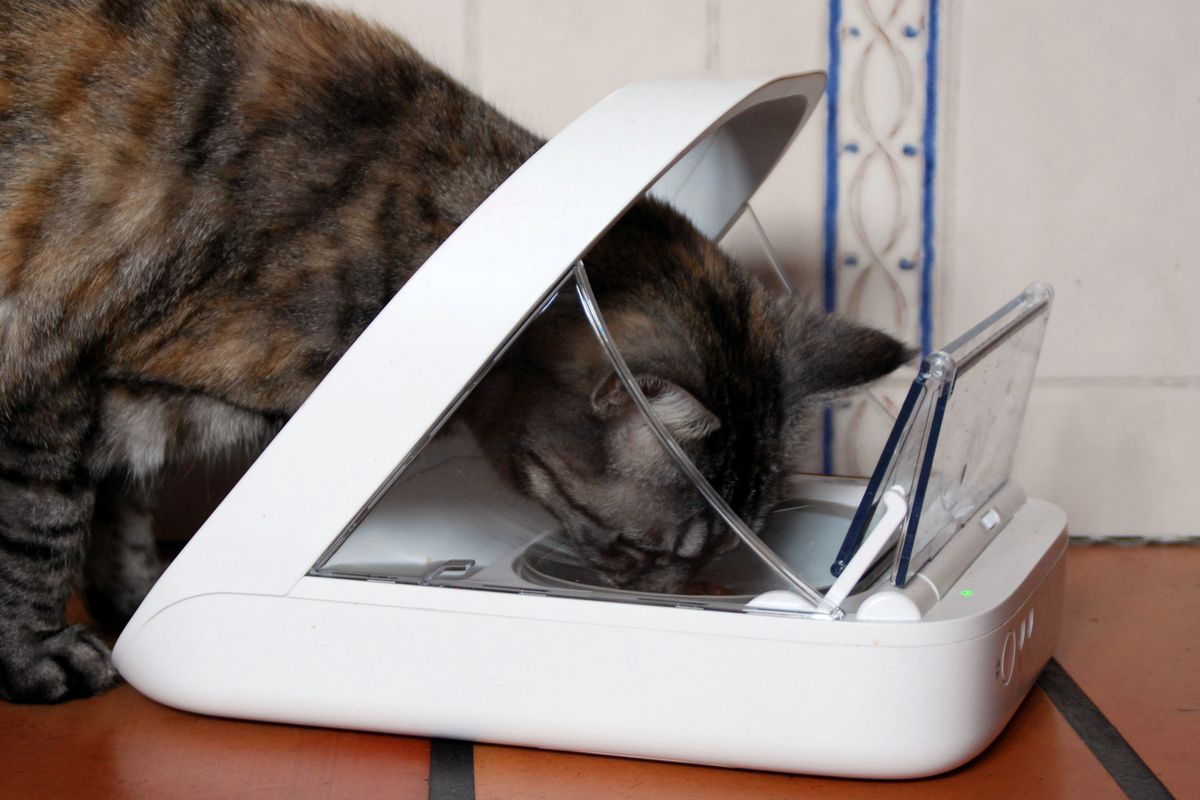
- More than one cat? One feeder per cat, spaced apart, or a microchip feeder that opens only for the registered cat’s chip or collar tag, if one cat steals the other’s meal.
Step 5: The products, compared
| Product | What it does | Good for | Watch out for | Shop |
|---|---|---|---|---|
| Programmable dry-food feeder (hopper with timed portions) | Drops a set portion at set times | Most 5am breakfast cats on dry food | Check kibble size range, portion size, lid lock, and battery backup. Determined cats may tip lighter models. | Check on Amazon |
| Wi-Fi / app feeder | Same as above, with schedules and meal logs on your phone | People who want to tweak times from bed, or who travel | Needs your Wi-Fi to be reliable; confirm it keeps the schedule offline. | Check on Amazon |
| Timed wet-food feeder (rotating trays with ice packs) | Opens one covered compartment at a set time | Cats who eat wet food for breakfast | Fewer meals per fill; freeze the ice packs and follow how long the maker says wet food can sit. | Check on Amazon |
| Microchip / RFID feeder (e.g. SureFeed) | Lid opens only for the registered cat’s microchip or collar tag | Multi-cat homes where one cat eats the other’s breakfast | A selective feeder, not a hopper: you still need to fill it or pair it with a timed approach. Confirm your cat’s chip type is supported. | Check on Amazon |
| Treat ball or puzzle feeder | Makes the cat work for part of its food | Bored cats; a small portion of the night’s food left out at bedtime | Start on the easiest setting. Rolling balls are noisy on hard floors at 3am; a stationary puzzle is quieter. | Puzzle feeders · Treat balls |
| Wand toy | Lets you run a real hunt-style play session before bed | Every cat in this guide | Put it away after play so it stays interesting, and so the string isn’t chewed unsupervised. | Check on Amazon |
| Under-door draft stopper | Closes the gap a cat reaches under and rattles the door with | Closed-door households with a hallway scratcher | Won’t stop meowing. Pick one that slides on the door, not one that just lies on the floor. | Check on Amazon |
| White noise machine | Masks the feeder motor and low-level meowing while the habit fades | Light sleepers during the transition weeks | A comfort fix for you, not a cat fix. Keep the volume moderate. | Check on Amazon |
These are examples of each product type, not ranked picks. Inclusion is not a paid placement; check the current listing for size, price, and what’s included before buying.
When the feeder “didn’t work”
- The cat now yells at the feeder 30 minutes early. That’s progress: they’re yelling at a machine, not you. Hold the time steady for a week, then move it later in small steps.
- The cat still wakes you after eating. It’s attention now. Ignore it, add evening play, and give your morning affection only once you’re up on your own schedule.
- The cat wakes you earlier than before. The feeder time may be too late. Move it a bit earlier, let it work for a week, then creep later again.
- The cat breaks in. Look for a locking lid and a heavier base, or put the feeder against a wall or in a corner so it can’t be pushed over.
- A partly eaten bowl still counts as “empty.” Some cats only want fresh food; smaller, more frequent portions help.
What to skip
- Spray bottles, yelling, or pushing the cat away roughly. It doesn’t teach “sleep in,” and it can make them wary of you.
- Leaving a giant bowl of food out all night. It may stop the wake-up, but free-feeding makes it hard to control how much your cat eats.
- Getting up “just this once.” It resets the clock on everything above.
- Motion-activated air sprayers by the bed. They startle rather than teach. We don’t list them.
If an older cat suddenly gets much hungrier, louder at night, or starts losing weight, mention it to your vet rather than treating it as a habit problem.
Quick decision path
- Wakes you, eats, sleeps? Timed feeder set just before their wake-up time, then move it later slowly.
- Eats and keeps pestering? Add bedtime play and a late snack, and stop responding to wake-ups.
- Started when the clocks changed? Shift meals 10–15 minutes every few days.
- Wet-food cat? A tray-style timed feeder with ice packs.
- Two cats, one food thief? One feeder each, or a microchip feeder.
- Scratching the door? Keep it consistently closed or open, and add a slide-on draft stopper.
Related guides
Find more cat fixes on Pinterest!
Follow Cat Solutions That Work